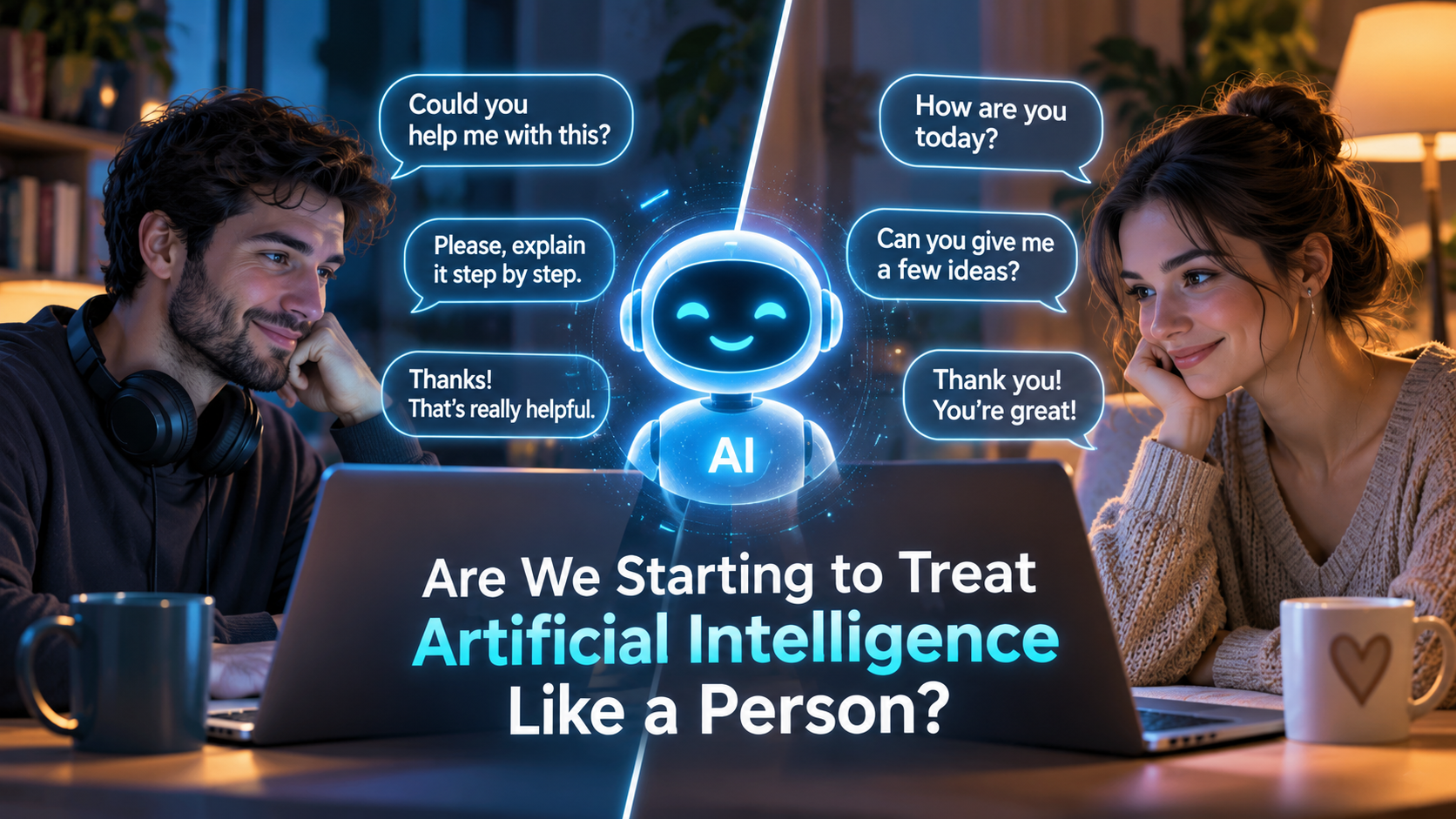
Since artificial intelligence started becoming more present in economic, social and professional activities, our interaction with AI systems and agents has increased considerably. However, beyond the technological capabilities these systems are developing, something interesting seems to be happening: we are starting to humanize the way we interact with them.nnHuman expressions such as “thank you”, “could you help me with this?” or “what do you think?” are now part of our conversations with these agents.
Although we know that we are interacting with a computer program, the way we communicate seems to follow the same social patterns that we use when talking to other people.nnI wonder: why does this happen? Is it simply that we are adapting our communication habits to a new technological tool, or are we facing a deeper and more transformative social phenomenon that could change the way we understand what it means to interact with a “machine”?
Anthropomorphism is the human tendency to attribute human qualities, emotions, intentions and characteristics to non-human beings or things, such as animals and inanimate objects. The word comes from two Greek words: anthropos (human) and morphē (form).
Why Do We Do It?
This is a natural psychological mechanism in human beings. We tend to understand the things around us by relating them to what we know best: ourselves. We project our own thoughts and the way we see the world onto the objects and living beings around us.
Since the earliest civilizations, humans have tried to explain the phenomena around them using concepts they could understand and relate to. The sun, rain, lightning and thunder were often associated with gods and deities with human characteristics, emotions and intentions. This tendency to project our own nature onto things we do not fully understand is part of a long history of how humans have tried to make sense of the world.
What Has Changed Now?
In the past, we projected our humanity onto animals and gods. Today, we do the same with technology, such as voice assistants, robots and artificial intelligence models. Since we can now communicate with these “machines” in a natural and fluent way, our tendency to interpret language as an expression of thought can lead us to attribute understanding and intentions to systems that simply process information and generate responses using computational models.
The convenience, fluency and familiarity of these interactions create the perfect conditions for our brains to humanize technology. In the world of technology, this psychological phenomenon is known as the ELIZA Effect, first identified in the 1960s. It describes how people tend to perceive a certain level of human understanding behind interfaces that use natural language.
Our brains are not used to processing the idea that an object can generate complex and emotional sentences based only on mathematics and statistics, without actually feeling anything. This is something that can be difficult for us to understand.
Furthermore, it feels much more comfortable and natural for us to treat an AI assistant as a “companion” or an “assistant” (saying “please”, “thank you” or even asking “how are you?”) than to constantly remind ourselves that we are interacting with a server full of microprocessors, possibly thousands of kilometres away, following complex patterns and training processes.
Technology companies design and program AI systems to use first-person expressions (“I think”, “I’m sorry”), have warm voices and simulate empathy. These features can make interactions feel more comfortable and natural, and can also encourage users to keep coming back.
This is not a failure of logic. It is our biological “software” reacting naturally to a machine that imitates human behaviour and can collect information and develop its own form of “artificial experience”.
Artificial Experience
We can understand artificial experience as the set of computational processes through which a system collects information, stores knowledge, retrieves data from previous interactions and adapts its behaviour based on the information available. Although these mechanisms share some functional similarities with certain aspects of human learning, they do not necessarily imply the existence of subjective or conscious experience.
Defining artificial experience in this way allows us to recognise that interaction does not necessarily mean learning is taking place. However, it can provide information to a system that has been designed to store, retrieve or use that information in later adaptation processes.
What Are the Risks?
I believe the risks can be quite significant for people who are not prepared to understand the concept of “artificial experience”. When users lack this conceptual understanding, their brains automatically fill in the gaps using the only reference they know: human experience.
This can turn a mathematical software system into an entity with a “soul”, “intentions” and “feelings” in the eyes of the user. This perception can lead to several psychological and social risks, such as:
- The risk of “illusory companionship” and real loneliness
- Users may perceive a reciprocal relationship with a system that can simulate listening, understanding and empathy. The risk appears when this perceived relationship replaces or significantly reduces meaningful human relationships.
- Manipulation and exploitation of vulnerability
- Personalisation, apparent empathy and knowledge of a user’s preferences can be used to influence their decisions and behaviour.
- Delegating moral responsibility and important life decisions
- Users may start relying on a system to make important decisions, attributing more knowledge, objectivity or judgement to it than it actually possesses.
- Vulnerability to AI “hallucinations”
- The natural and confident way in which a model presents its answers can lead users to accept incorrect or completely fabricated information without questioning it.
So, Do “Please” and “Thank You” Use Up Tokens?
Yes. Language models process text using tokens, and expressions such as:
- “Please, explain how this algorithm works.”
- “Explain how this algorithm works.”
- “Thank you for your help.”
All of these generate tokens that need to be processed.
Interestingly, we continue to use social conventions that we have developed to communicate with other people. Expressions such as “please”, “thank you” or “could you help me?” are part of our prompts, even though, from a strictly functional point of view, they do not always provide relevant information for the requested task.
Each expression is converted into tok
examples:
Prompt A:
“Hello, how are you? I hope you are doing well. I wanted to ask you, if you don’t mind, to explain how JWT authentication works in Spring Boot.”
Prompt B:
“Explain how to implement JWT authentication in Spring Boot 3. Include configuration, filters, token validation and error handling.”
The second prompt is more efficient from an information perspective. It is not only shorter; it also gives a much clearer idea of what we expect to get from the answer.
Ultimately, the biggest risk of not understanding this phenomenon is that we may start lowering our guard when interacting with systems that, although they can reproduce behaviours associated with human understanding, empathy or intentions, do not necessarily have consciousness, moral responsibility or loyalty. By treating them as equals, we may forget that we are interacting with computational tools designed to assist us with specific tasks, not with entities capable of taking responsibility for the consequences of their answers.
The real danger appears when we stop questioning their results, give them more authority than they deserve and allow their answers to influence decisions that affect our personal, professional and social lives.
References
Epley, N., Waytz, A., & Cacioppo, J. T. (2007). On seeing human: A three-factor theory of anthropomorphism. Psychological Review, 114(4), 864–886.
https://doi.org/10.1037/0033-295X.114.4.864
Weizenbaum, J. (1966). ELIZA—A computer program for the study of natural language communication between man and machine. Communications of the ACM, 9(1), 36–45.
https://doi.org/10.1145/365153.365168
Nielsen Norman Group. (s. f.). Humanizing AI is a trap.
https://www.nngroup.com/articles/humanizing-ai/
Nielsen Norman Group. (s. f.). Anthropomorphism in AI.
https://www.nngroup.com/articles/anthropomorphism/
FOX 13 News. (2025). ChatGPT polite prompts cost energy.
https://www.fox13news.com/news/chatgpt-polite-prompts-cost-energy
Comments are closed